An Overview of the Systems That Make Your Voice Work
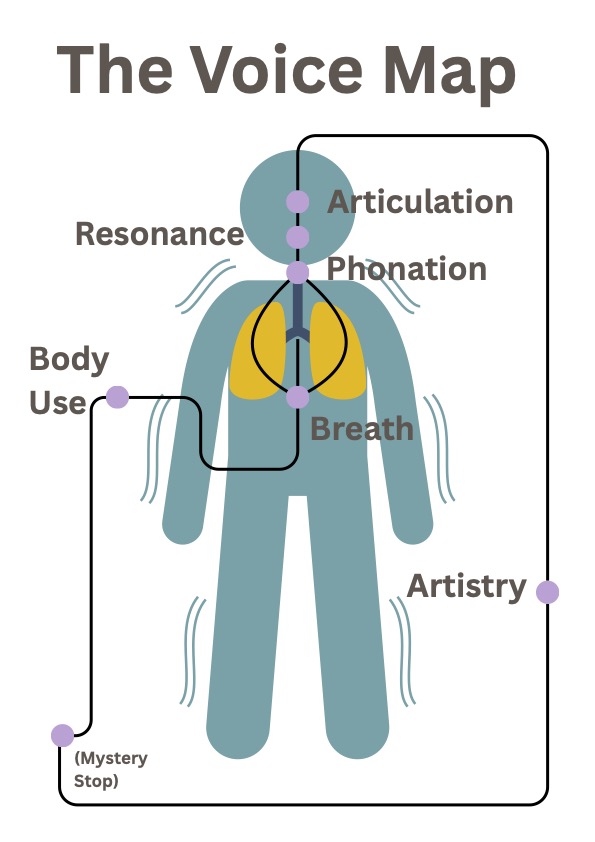
Welcome
If you’ve wondered why your voice behaves differently from day to day, why you can belt one day and not the next or why breath and tension feel like very hard codes to crack, you’re in a large club.
Most of us learn pieces of the puzzle: a breath exercise, posture cue, vowel adjustment applied to one word or phrase.
As you know, your voice isn’t isolated components. It’s a system made of systems, and each affects all the others.
When you understand how those systems work together, you stop fighting your body and start collaborating with it. (aaaahh sigh)
That’s what The Voice Map is for: to give you a clear, big-picture understanding of how your voice works as a connected, living instrument.
Systems of the Voice
Think of this like a metro map.
Each system is like a major junction stop, and each station talks to the others.
Each stop represents something you can adjust to see how it affects the whole system.
And together, they connect to form your full, expressive instrument.
1. BODY — Your Foundation
Your body, your voice’s physical home.
Alignment, balance, and freedom of movement let the rest of your systems function efficiently.
Static engagements (muscular holds) are our bodies’ protectors, and when we look at them with curiosity, we can add movement and dynamic freedom in the whole instrument. (No more train stuck in the tunnel :)) (I won’t train analogy dad-joke you excessively, promise.)
Core ideas:
Singing begins with mobile awareness, not rigid position. If you’re singing, you’re moving.
The body needs to move to balance.
Release is not collapse; it’s dynamic support – some things engaging while others soften.
Try this:
Standing or sitting, feel your feet on the floor, and witness the ground supporting you below.
Then sway gently side to side until you feel your weight settle evenly through your feet or sitz bones.
Soften your knees, relate your knees to the middle of your feet. Now witness your hips. Notice how your pelvic bowl mirrors the downward bowl of your diaphragm. Notice how your ribs float over the pelvis and how your ears float over the ribs. Take your attention back down into the ground and then imagine a fountain moving right up through the top of your head. Repeat that image a few times.
Notice any areas of static engagement, and look at them with curiosity and gentleness.
Does this affect your energetic relationship to yourself or change the way you’re noticing your breath?
Reflection:
Where in your body do you feel ease or engagement? What happens when you give these areas gentle, curious attention?
2. BREATH — The Invigorator
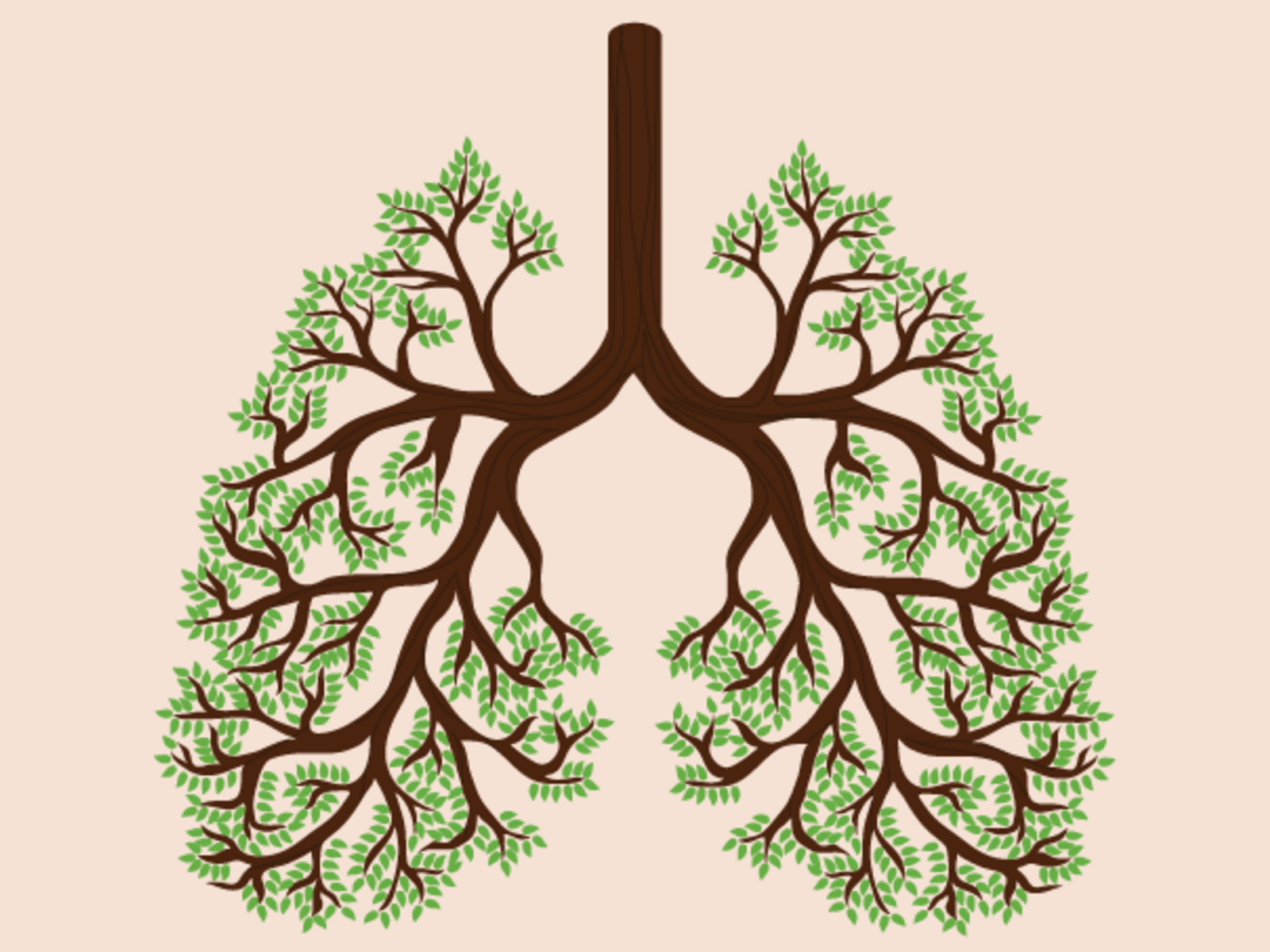
You already know – no breath, no vibration. Your breath system connects body movement and vocal vibration. And keeps you alive. Thanks! 🫁
We want to allow air to move efficiently in and out of a responsive torso.
Core ideas:
Breath is always moving.
The torso can be supple, and there are many ways to breathe both in and out when we sing different styles.
Try this:
Let out all your air.
Then allow the breath to fall in through your nose by releasing your belly and watching your ribs open.
Notice how your body inhales and exhales itself; it knows how to breathe all night as you sleep.
Reflection:
When you sing, do you feel like you have to make the breath happen? Or watchand collaborate with it?
3. PHONATION — Where Vibration Happens
This is where the breath creates and energizes sound: the vibration of your vocal folds.
Phonation is not a push or squeeze. It’s a coordination of air velocity and tissue that creates vibration.
Core ideas:
Your folds need just enough closure, a balanced event, and you’re going to have different kinds of closure and phase rates depending on what kind of style or phrase you’re singing.
Balance happens when breath flow and closure get to collaborate.
Your tone quality changes when that relationship shifts. And there are all kinds of shifts you can work with.
Try this:
Close your lips, let some air move out through your nose, then hum softly in a very comfortable pitch range.
Then, open your mouth and let a sigh out on whatever vowel you like.
Repeat and notice how the vocal folds begin to vibrate. Know that the movement of your air helps your folds come together. Starting with a little bit of exhale before the vibration helps our brain to see the different components of onset.
Keep playing with this simple exercise and be curious about how your voice has learned to vibrate and coordinate with your air.
Reflection:
I like to think about how amazing it is that a mechanism the size of a dime inside your larynx is capable of so much. Spend some time noticing that and thinking about it and see how it may change your singing.
This one is very helpful for explaining onset –
4. REGISTRATION — Coordination Continuum
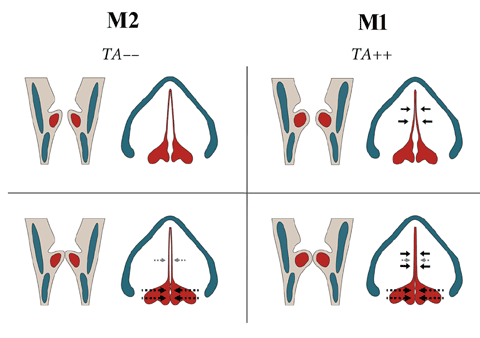
There’s no separate mix register, and you can’t mix head and chest like flour and sugar. Most vocal coordinations produce a mixture of sympathetic resonances (head and chest).
You have one instrument capable of many densities and coordinations.
Your registers are different muscular and acoustic coordinations within the larynx and tract.
Core ideas:
Mode 0 – pulse or fry
Mode 1 = thicker fold engagement, the body and the cover of the folds vibrating (what we call chest).
Mode 2 = thinner fold engagement, mostly just the cover vibrating (what we call head).
Mode 3 = Whistle
Mix = coordination, usually experienced as a low density Mode 1 or a higher density Mode 2.
Try this:
Do a gentle whoop siren from low to high.
Let the voice flip, wobble, or blend however it wants. Be curious about where things naturally change for you.
Your folds are exploring your individual map. Notice where the voice naturally changes from M1 to M2 going up and coming down.
Reflection:
What do your register shifts feel like today? Smooth, abrupt, somewhere in between
Knowing where the voice naturally wants to transition gives you registration agency for when you want to make mode change choices.
5. RESONANCE — Sound Shaping
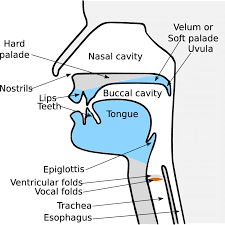
Resonance is your acoustic design system.
It’s how you shape your vocal tract, the space from your folds to the opening of your mouth or nose, to tune and amplify your sound.
Core ideas:
You don’t place sound (it always moves); you shape space.
The larynx, tongue, jaw, soft palate, and pharynx are adjustable acoustical tools.
Tiny shifts in shape = significant shifts in sound and feel.
Try this:
Say [ng] (as in “sing”) and then open to [ah] while keeping the back of your tongue soft.
Notice how the vibration changes and moves from your nose to coming through your mouth. (Not because you brought it forward or put it somewhere, but because you changed the acoustic and tract coordination.)
Notice the activity of vibration in your pharynx.
Reflection:
Where do you sense resonance most? And what happens when you pay attention to where you naturally notice it rather than trying to produce it in particular places.
Just because one person feels a ton of sensation in their front sinuses, upper chest, or skull doesn’t mean you will, too.
And here’s the entire vocal tract playlist.
6. ARTICULATION & EXPRESSION — Clarifying Image and Story
When vibration and resonance begin to balance, we then continue to sculpt with phonemes we recognize as words and meaning symbols.
This is where your voice flows through specificity of image, and you zero in on economy of movement with the muscles of articulation.
Core ideas:
We always want to experiment with lively and gentle engagement of the tongue, lips, teeth, and jaw muscles; clear articulation comes from clear image and economy of movement.
Consonants clarify meaning; vowels house tone and soul. It’s not even that separate. An [n] or [m] or [v] can carry a lot of soul, too. It’s just important that we witness energized air moving through all of it.
Authentic point of view, therefore emotion, can organize your technique.
Try this:
Speak a line from a song you love; feel the text vibrate through as you speak it, and see the images. (When the rain is blowing in your face and the whole world is on your case….)
Now sing it slowly in a comfortable range, letting yourself witness the images and notice the vibrations of your voice as the phrase comes through.
Now ask yourself if the articulation energy could feel even gentler. Sing it again with softer muscular engagement of the tongue, teeth and jaw.
(🇮🇹 I like to call this coordination Italianate. Give your consonants a slightly Italian feel. This often brings articulation to the front and creates more space in the oral cavity.)
Notice any differences?
Reflection:
How do you want your voice to feel as it comes through you? If you could give the person hearing you sing a gift through your sound, what would that be?
Putting a Lot of it Together
A favorite author of mine is Richard Rohr, a Franciscan, and he describes the presence and reality of God as a circle dance. I believe the systems of our voice and body work in a very similar way.
Body ↔ Breath ↔ Phonation ↔ Registration ↔ Resonance ↔ Articulation → Artistry
Each one affects and contributes to the one upstream and downstream.
When one system feels off, it’s often because another system could use gentle attention or release.
So rather than chasing symptoms like “fixing breath support” or “finding placement” you can start tracing which system could use your awareness.
And the great news is that each system affects the other so you can start in many different places and find your way very well.
That’s the good news about the idea of The Voice Map.
It helps you see your voice as a connected, responsive instrument that already knows how to sing. And it helps you feel excited about the mystery of it while you have plenty of agency over things you can affect.
Mini Practice Prompt
Choose one phrase of a song you love.
As you sing it, ask yourself:
- How dynamically grounded is my body?
- How efficient and balanced is my breath?
- Is my phonation responsive and coordinating with breath??
- How am I transitioning between registers?
- What shape is my resonance taking? Is it being helpful to the vocal task?
- What emotion or message am I experiencing while I share this phrase?
If one question lights up some energetic curiosity for you, spend time exploring that system and notice how it affects the others.
You’ll start to work for a framework of connection and your nervous system will automatically connect these seemingly separate places and soon they’ll be working as a beautifully cooperative team.
When You’re Ready for More
If you’d like guided support applying this framework in depth, The Voice Map expands on everything you’ve seen here with structured lessons, demonstrations, and practice pathways.
It’s designed to help you coordinate body, breath, phonation, registration, resonance, articulation, and artistry — not as isolated skills, but as a connected, responsive system you can return to over and over.
About Your Teacher
I’m Dan Callaway. I teach Musical Theatre Voice and Vocal Pedagogy at Boston Conservatory at Berklee and work with professional and pre-professional singers through my private studio, online courses, and educational resources.
My work focuses on helping singers understand how their voices function as integrated systems, so technique becomes clearer, more reliable, and more adaptable in practice, rehearsal, and performance.
If you’re ready to work with this framework more deeply, you can learn more about The Voice Map below.