When I filled out the form with my show info, there was a spot where you could put all your stellar reviews.
Something in me hates doing the “Dan Callaway stupefied audiences by singing the first two A sections of ‘If I Loved You’ in one breath” thing. I don’t know what it is.
I suspect it’s arrogance — I’m above these lowly marketing ploys. I’ll just go for a nature hike, listen to birdsong, and think about lyrics, and the folks will just come see the show.
But I went ahead and wrote in the answer box something like, “Can I not? I don’t wanna Google myself.”
I even went against show description convention and wrote mine in dialogue form:
You: Who are you?
Me: I’m Dan! I sing songs, and you’ll like hearing them.
The folks at Green Room 42 were like, “You need to do it like we clearly show you on the form.”
All right, all riiiight. You know how this is done. I’ll do the rules.
I followed the format.
And then I spent a lonely night in bed while Melissa was visiting Rhode Island, cough, googling myself and scraping up digitized microfilm of reviews that may have said something favorable about me.
One theme I did discover: one LA Times theatre critic was consistent in his dislike of my work.
And after a couple hours of self consciousness purgatory, I pulled out 5 or 6 nice things other folks said. Some were even surprises from my “I don’t read reviews” period.
That swearing-off of came as a result of reading things that I didn’t need to google. Because they’re seared into long-term storage.
Things like “Callaway is suitably bland in this role,” or “He had a good start but just didn’t have what it took to finish strong,” or my personal favorite: “He was upstaged by his mullet haircut.”
(And I assure you it was not a mullet. There was equal distribution of party in the front AND back.)
Putting yourself in front of folks is hard.
And you can tell yourself “It’s not personal,” all you want, but it’s personal.
It’s you. Your identity, values, process, point of view, and soul are all part of what you share with folks, and when people bat that down, it hurts.
And I’m convinced the pain of what people may say is better than the pain of shutting yourself down.
In fact, opinions like this are evidence that you have a point of view. You’re sharing something specific. And there’s satisfaction in that.
Think of the performers whose work you don’t care for. They’re still doing their thing. Good for them.
So, I hope this will give you permission to do some whole-hearted horn tooting, to get yourself in front of folks and tell your stories.
And do remember, there is only one you, and folks need to hear the story only you can sing.
Love much,
Dan
PS I want you to know about my dear friend Bobby Apperson’s creative synergy magic going on in East Hollywood (and wherever you have an internet connection): Songsmith LA.
If you need a boost in getting your self and your songs in front of folks, their training in singing, playing, songwriting, and producing will give you what you’re looking for.
Check them out, and reach out to Bobby if you have any questions.
PPS Want a peep into the set list?
Here are a few things cooking so far. If you got any uptempo suggestions for me, tell me! (I always wanna sing slow, sad ballads.)
Unexpressed (John Bucchino) Ain’t it a Pretty Night (from Susannah, Carlisle Floyd) Change (from A New Brain, William Finn) Anyone Can Whistle Crying (Roy Orbison) A Case of You and Both Sides Now (Joni Mitchell) Chain of Love (from The Grass Harp, Claibe Richardson) The Dream (Rufus Wainwright) See What it Gets You (from Anyone Can Whistle) Rhode Island is Famous for You (Dietz and Schwartz) Shine (from The Spitfire Grill, James Valcq and Fred Alley)
One time a director I respected said after an opening night, “Dan, you know what you’re doing. You just have to trust yourself.”
It meant a lot to me. And I immediately asked in my head, “Can someone please tell me how exactly one goes about trusting oneself?”
(I would go on to several years of doing just the opposite.)
When it came to career stuff, I searched and waited for this substantial self-belief I heard folks talking about.
Believe in yourself!
Look in the mirror and say in a low breathy yoga teacher voice, “I am a powerful, successful, cosmic star of stage and screen with an EGOT and nice enough abs.”
(I did have an agent one time instruct me to pull up my shirt to assess my belly, so this was a thing.)
But this feeling of invincible confidence never alighted, and I walked around thinking something must be wrong and that I might not belong in the places I wanted to sing after all.
I mean, those folks had nicer and much more smoldery headshots.
Generating all this anxiety juice was a belief I’d picked up. Maybe it was Mr. Rogers saying I was special combined with singing “One Moment in Time” in 7th grade chorus. Whatever its origin, this credo permeated everything.
Here it is:
I have to believe in myself.
This one tripped me up for years. Still does.
Where did my self belief go? I’m sure I left it right here.
So elusive.
Whoah, I must have said that out loud because here’s a news story in my Google feed about “7 Ways to Achieve Unstoppable Belief in Yourself.”
And this online course.
Oh, and YouTube heard, too.
Thanks, nosy algorithm. You always know what to serve up so that I can deceive myself that I’m making steps toward my soul’s longing through constant input, research, and notification checking.
Seriously, though, there’s that belief, right?
I need to believe in myself.
I don’t think you do.
We waste a lot of energy and brain glucose trying to conjure a Marvel hero mind-state when we could just start repeating a lyric and seeing how it lights up in our imagination.
That would be one building block of a song you’d have added to your artistic structure, and it also adds stone and mortar to something that does indeed come in handy:
CONFIDENCE
Wait. Belief? Confidence? Samesies, right?
Nope.
Confidence comes from the Latin meaning with (con) trust (fidere).
When you trust something, there’s usually a basis for that trust.
And the basis for that trust is your skill.
And in order to build your skill, you have to show up regularly and do the things that build that skill.
And in order to show up, the only thing you need to believe is that if you keep doing the things that lead to vocal freedom, expressive honesty, and creative fulfillment, you’ll sing great, open your heart, and do work that satisfies you.
None of this requires you to believe in yourself.
In fact, as soon as you stop requiring yourself to have this assurance, you can start doing the simple (not easy) work of daily noise making, story telling, and then sharing it with folks.
And anywhere you start is fine.
One action, even if it needs some prerequisites, will reveal what you need to go back and bolster, and you can take it from there.
It’s messy. It’s frustrating. And it’s worth it.
Because while I don’t think you need to believe IN yourself, the thing that’s crucial is to believe yourself.
This means noticing when your body vibrates with excitement and possibility. And when it contracts.
And actually listening to that. It’ll lead you in all kinds of unexpected directions.
I’ve noticed lately that I’ve been ignoring my body brain in favor of my noggin brain, and it’s caused a lot of futile trying and anxiety.
When I’ve tuned in and acknowledged what my body’s vibing — that I want to share more singing in more places — I don’t know how it’s all happening, but things are already flowing.
I’ll keep you posted on that.
In the meantime, please take a sec to check in with your own body. Is the path you picked feeling good in your cells? It’s not a joke. You came to the planet with a good guidance system. I invite us to use it.
Because it’s true — there is only one you and only one me. And folks need to hear the story only we can sing.
I went ahead and booked a date to do a show in NYC. (It’s Saturday, Oct. 7 at 1pm at The Green Room 42 if you wanna mark your calendar. Tix avail once I get my form all filled out.)
I booked it because I found out my very SPECIAL creative resistance isn’t your garden variety opposition.
Oh no, your singular unicorn enneagram 4 here has to have the stealth, undetectable kind of creative blocks that can shape shift into all manner of benevolent forms.
Some manifestations include —
Telling myself I should only focus on one thing (prolly just teaching.)
Telling myself that taking time to work on creative projects is selfish and makes me a substandard dad and hubby.
YouTube videos.
I told you a couple weeks ago about how I got the tappity tap on my shoulder to start walking my talk and put my money where my mic is. ?
So, I did.
Now I’m like, “Woo!” And “Crap.” But mostly “Woooo!”
I got in my studio early this morning and started making noises and breaking down the opening number I’m planning. It might be a terrible idea, and it might, as the kids say, slap.
We’ll see.
But right now, there are some parts that are bad.
Noah heard the video playback as I toasted waffles this morning, and said, “Daddy, you’re not the champion of the Frozen 2 song.”
(See? Maybe a terrible idea. I’ll keep you posted.)
That’s what all this processy stuff is for.
Things I remembered this morning I wanna share with you are —
2 questions you need to sit with and know for yourself song by song and phrase by phrase:
Who am I?
What do I believe is happening?
The answers to these will guide every vocal decision you make. If you don’t have a clue about these ideas, you’ll lack a very important compass.
You’ll jump in to making sounds and learning notes disconnected from the meaning of the song, and if that’s not clear to you, it won’t be clear to folks listening.
And while you may sound objectively terrific, the reason you’re singing at all will be lost. (Sounding good isn’t a good enough reason.)
I get anxious about whether or not I can make the sounds well, so I rush ahead to make sure I can figure that out.
I have to slow down and let these questions percolate, give myself some time not to know, and even let them bubble while I go about my day. Usually the fun answers come when I’m scrubbing something or walking somewhere.
Always ask those questions.
In each song, even if you’re being you and not playing a character, you’re expressing a facet of your identity, and there are thousands of possibilities. And that point of view is gonna inform how you make sounds about what you think is happening.
The other crucial thing for me is to video myself.
This provides empirical evidence in all directions.
I listen back to things I think must have sounded rough, and I’m pleasantly surprised. Or I listen back to something I think I nailed, and I’m like, whoah, I’m gonna need to approach that differently.
This happens a lot with intonation. I’ll hear the fundamental frequency strong in my inside hearing, but the way it comes out in the room is flat. Womp womp.
I have to shape my tract with more bright color to mitigate that. It sounds too bright in my head, but I listen back, and I’m like, “Oh, ok. That’s solid.”
You’ll also listen to yourself with empathetic mirror neurons and be able to feel where you have inhibitors and energy blocks.
Happened to me today as well. I listened back and felt constriction around my larynx a couple times — “Hmmmm. That felt pretty good when I sang it. But listening back alerted me that there could be more ease and freedom.”
I’m excited, and it feels great to listen to your heart and walk accordingly.
There’s gonna be some Roy Orbison, Tracy Chapman, William Finn, Rufus Wainwright, Bonnie Raitt, Mr. Sondheim, Craig Carnelia, Carlisle Floyd, Joni Mitchell, Paul Simon, and songs from The Grass Harp and The Spitfire Grill. That’s the plan right now.
I’ll let you know if it becomes an all-polka show.
And I’m joined by my friend and colleague Scott Nicholas on keys who is the objective bees’ knees. ??
And if you want a little more behind the scenes on how to construct a program be it for your own cabaret, one person show, or plaint to a credit card customer service because you blanked on your payment date, I made you this video:
Always remember — there’s only one you, and folks need to hear the story only you can sing.
In fact, I think that’ll be the title of my show — “Only One You.” See how you inspire me?
Boom! Now go sing.
And
Love much,
Dan
PS I’ve recently discovered Nahre Sol’s YouTube channel — classically trained pianist Juilliard grad who shares terrific in-depth content on what she’s working in. Recommend!
PPS If you haven’t read Steven Pressfield, he has a terrific book called The War of Art.
When I was in the UK right after college, Tom and Joanna Gillium took me in like one of their own.
I was their 22-year-old adoptee getting thrown in the Ford Transit van with their 5 kiddos, and it was terrific.
I dropped stuffed animal bombs over the stair railing with their five year old, Tim. I played ping-pong with Hugh. Felt completely lost trying to keep up with Rosie and Ali quoting Ali G at the lunch table, and felt even more lost when their eldest, Ed, tried to teach me about football. ⚽️
They fed me lunch almost every Sunday, took me along to Kensington Gardens to walk their dog Buxton, hooked me up with a room in a beautiful house (while my rent went to charity), and got me a terrific pub job where my love of cooking took off.
They were a major influence in my life and cultivated my value for hospitality and folks getting together to eat.
One summer, they invited me to spend some days with them at their family’s house in the North York Moors.
What a stunning place. We hiked, we ate, we drink whiskey in front of the fire, and we had a terrific day by the sea in Runswick (which I mistakenly called Bruswick for many years). Most of that village got to hear my primal howl when I breached into the water — still frigid in August.
I noticed by about day three of my Yorkshire holiday I started to get twitchy.
I felt guilty about all of this rest and leisure I was enjoying. And I looked at my sweet Gillums, and I wondered how exactly were they able to rest they way they did. It looked that way to me, anyway.
But I noticed it then — I couldn’t chill the boop out.
I still haven’t earned my merit badge for hammock swinging.
Last Friday we went to hang out with the family of one of Noah’s preschool friends (what if we could love and hug each other like 5-year-old besties ps? — so sweet).
Dad Brendan’s from Massachusetts, Irish heritage, and Mom Gabi is from Brazil. There were other Brazilian friends there, and ridiculously good food.
When we arrived I was frazzled, stressed, tired, and real prickly, thinking about all the work I wasn’t getting done.
After we left, I said, “We clearly needed some Brazilian friends.”
How can you be stressed with delicious steak, a beer, and bossa nova playing?
This lesson is showing up for me. It walks in gently and invites me to rest. I usually refuse the invite.
But it’s so crucial. I’m seeing this. Maybe.
And there are glimpses recently that when I do RSVP yes, work-related blessings from surprise sources fly in the door. Funny.
This week we’ve been invited to visit our friends at a beautiful lake in New Hampshire.
I’m DETERMINED I’m going to RELAX :).
Seriously, though, pray for me, saints. I miss moments of beauty, wonder, thank-you, and wow on a regular basis because I think that person is really waiting for my email reply.
I’m not that important, and what terrific information.
Anne Lamott wrote, “Almost everything will work again if you unplug it for a few minutes… Including you.”
I’m gonna take her advice. I’m inviting you to as well.
(And don’t do what I do here — relax with a PURPOSE — I’m gonna relax so I can….. See? I need help. Lordt.)
I’ll keep you posted.
In the meantime, in the next few days, where can you dedicate some moments to genuine turn-off-your-phone rest time? I’d love to hear what you cook up. I need recipes.
And do remember there’s only one you, and folks need to hear the story only you can sing.
If you’ve had any degree of vocal training in the Western classical tradition, you’ve encountered the 24 Italian Songs book.
Folks love to hate on em. You can search the YouTubes and find a lot of nascent singers doing their best.
You can also find some of the world’s greatest like Cecilia Bartoli bring them to stunning life.
Theatre singers often give these the hard eye roll because they can’t see how a 250-year-old art song is gonna help them nail that Hairspray callback.
And they’re right. It’s not a direct line. Add to that most singers don’t take the trouble to find out what they’re singing about, and yeah, absolutely — you’re in irrelevant-to-me snooze town right away.
But when you’re a theatre singer, you get to embody countless stories and folks, and that means countless sounds. And these songs have a lot to teach us about how to access those in beautiful, soul sharing ways.
I’m remembering reading the program notes from Betty Buckley’s concert at the Donmar Warehouse in 2000; she talked about how her core training was in bel canto technique, and you can hear the value for legato singing, communication of soul, and vibrant presence in everything she did/does.
Go listen to some “Memory” circa 1983 as well as the stuff she sang in “Tender Mercies” and you’re gonna hear legato flow in all of it. If there’s a theatre singer you wanna take a note or seven from, there you go.
These can give you the keys to flow in your breath and sound, vowel secrets and acoustic leverage, make your articulation clear and effortless, make you a flexible embody-er of character, give you terrific sound comparison tools, and show you how to mine the beauty in material folks call overdone.
Some days through a string of lessons, I’ll get super passionate about meeting your childhood survival tension with understanding or setting yourself free to make crazy noises, and I’ll drop an f-bomb or 12.
It’s my favorite one — It’s got that terrific fricative at the beginning, all manner of ways to shape the vowel, and ends with the fireworks of a voiceless velar plosive.
People say it’s uncreative and base.
Maybe.
It’s like Froot Loops.
My mama wisely didn’t buy them. (She was also on the front of the whole wheat bread train; I envied Greg Varney’s white-bread-no-crust bologna sammies in 4th grade.)
But once I had more agency over what was part of my complete breakfast, I couldn’t get enough high fructose corn syrup, chemical color, and questionably sourced grain circles down my gullet.
I’ve eased off of the cereals that leave an itchy film on your hard palate, but I still partake in regular profanity.
I also pray. I mean listen. When I’m stumped, I’ll get quiet, close my eyes, and I’ll see if any info bubbles up in my guts, some guidance on what would be most helpful for you.
Sometimes I’ll tell you how I follow Jesus, but that’s normally to clarify why I believe the greatest power in the universe is born of vulnerability. Or the only explanation I got of how the blind blunders in my life have somehow turned to gold.
There’s a long list of whys because it connects to everything for me.
I used to go to this psychic in Studio City, and every time I walked in, she’d laugh and say Jesus was with me again.
I got to work with MTCA (Musical Theatre College Auditions) last week in NYC, and it was terrific.
One thing I wanna tell you, well, two.
One — go ahead and sing the basic song that everybody sings.
There are 2 reasons for this.
Reason 1 is that the table people will already know it, so they can focus on you.
And that leads to reason number 2: If I’m listening to a new song, my brain will be split between you and the song itself.
What is this song? What’s the story? You have a lot more heavy lifting to do as the storyteller when you sing unfamiliar material.
And
Two — sing the basic song knowing that you’re the only one who can sing it like you do.
Objectively. Genetically, biologically, and on the level of your inimitable soul, you’re the only one who can sing it that way — which brings me to the real point.
Table people will know you can sing in the first couple of bars. What makes all the difference in the world is whether or not you open the door to your heart and invite folks in.
No one knows the secret things you’re singing about (and it’s none of our business), but we know if we’re invited into your singular, one-of-a-kind space.
When you do invite us in, your soul rises up, dissolves your ego, and shares beauty that you can’t even be aware of.
You’ll sparkle and love and care bear stare, and it’ll feel satisfying, beautiful, and a little like you’re doing nothing.
You’ve heard me talk about how New York City diner menus. They overwhelm me. I mean, who can choose between blintzes and a BLT?
(I’m remembering a woman I waited on at Artie’s Delicatessen who ordered French toast and followed it up with a slice of carrot cake. She didn’t have any problems choosing.)
I finally developed a technique of deciding the category of food I’d order BEFORE walking into the diner, and that helped.
But I’ve found that my menu overwhelm syndrome creeps up in other areas of my life.
And I’ll tell you why.
We get NYC menu-level info hurled at us every day. That is, you do if you get as attached to that little computer rectangle in your pocket with the candy-colored squares on its adorable little screen as I do.
Lately it’s been the YouTubes.
I told you last week about how I’m all about that INPUT. (Did you do your Clifton Strengths? They’re helpful, right?)
Input’s a wonderful trait for an educator. And it’s a PARALYZING flaw when you’re just trying to put one foot in front of the other toward that thing you decided was a priority.
But you get surfing on one algorithm wave, and all of a sudden you’re like,
oooooh, wait, maybe I need to break this all down in an Asana work flow. Hmmmmm. Will the free version be okay? How much money have I spent on software this year? No. Just use your paper checklist that’s been working. Did I pull those tasks from my Google Calendar? What about the bullet journal? How do these people post on Instagram so much? SHOULD we buy land and building and off-grid community with rentable yurts and compost toilets?
?
Then Melissa’s like, “Sweetie, you need some time? What’s up?”
And I’m all like, “Where do I even BEGIN? It’s MADNESS in here, I tell you! It all started with blintzes.
Melissa threw me a life preserver, though. ? (She may have gently aimed it at my head.)
She brought my brain back to our lived-in kitchen and toy-strewn living room and reminded me, “The summer’s gonna be over soon. Let’s enjoy this time we have together.”
Thank you, sweetie. It was so clear and simple.
I’m having a hard time appreciating the present lately. My brain flies off in the future, and the future looks like a diner menu with much higher prices.
So, these are some things I’m doing to help my brain.
Feeling wonky? How can you get back to HERE?
You’re gonna roll your eyes, but the answer almost all the time is paying attention to your breath. And it’s paying attention to your breath longer than you want to. I want to take exactly one and a half deepish inhales and feel balanced again.
Nope. It takes a little longer to travel from Agitation Station to Clarity Town.
The other thing is to notice things around you on purpose. And name them to yourself. The wall color, the birds you may hear, the loud train or smell of subway track grease. This helps. (Also key in an audition room.)
This, too, takes longer than I want it.
Siri, “Make me present, calm, and serene!”
One other thing: Phone a friend. Literally pick up that rectangle computer and call somebody. This, for some reason, is hard to do these days. Especially because we all assume something’s wrong when we get an actual phone call. So, maybe send a prelim text.
This is also especially hard for folks like me who want to solve everything inside the ole brain. One day I’ll accept this doesn’t work.
One other simplifying question that’s helped me is from James Clear’s book Atomic Habits.
It’s a question of identity.
If you want your identity to be someone who’s healthy and vibrant, you can ask yourself, “What would a healthy and vibrant person do?”
I’d drink a glass of water. I’d get out for a walk. I’d take some time to stretch.
If you ask yourself what you’d like your identity to be, you can then ask, “What would this kind of person do?” We almost always know. It’s just that the steps are often so simple, our brain’s like, “It can’t be that straightforward. Yawn. What’s on YouTube?”
That brings me to the next helpful thing: Getting where you want to go means doing simple/boring things over and over.
It’s not shiny and entertaining. It’s satisfying.
Once you stop expecting constant amusement to be a thing, you can start humming and stretching and learning that song you picked out for the cabaret you decided to put together (even though you feel scared. I always do.)
Then when you show up for the thing, those days and days of practice are in your body. That’s where confidence comes from, the skill you built.
The other one that’s helpful and very hard for me is seasons.
Right now is the time for — fill in your blank.
Right now is not the time in my life when I can do a lot of 730pm dinner meetups. I’ve got to put my boys to sleep mid-chapter of the next Chronicles of Narnia book.
Let’s review:
? Breathe for as long as it takes.
?? Notice things around you for as long as it takes.
? Connect in a real time present way with somebody you trust.
? Ask yourself, “What would a kind-of-person-I-want-to-be do?”
?? Then do it. Over and over, and look for the satisfaction not the entertainment.
? And notice what season you’re in.
Hope this was helpful for you. I’ll keep you posted.
In the meantime, you know what I’m fixing to say: There’s only one you, and folks need to hear the story only you can sing.
There’s an ongoing complaint that musical theatre rep keeps getting higher and higher. And that’s because musical theatre rep has gotten higher and higher.
If you survey what folks were singing generally in the 1950s and ’60s and compare that to what was shaking down just 20 years ago, you’ll see — things have changed, Raoul.
It’s like when a runner breaks a world record, humans want to see how much faster they can run. Same with singing — it’s a muscular event, and our mirror neurons want to witness the risk and excitement of high notes sung with skill and beauty.
And yeah, you’re right, there’s not been a race to the low frequencies in this regard, so a lot of folks with deliciously low voices are feeling very left out of the current commercial musical theatre market. I have thoughts on this that I’ll share with you later.
The shape of musical theater singing changed in the 1960s, really with the advent of HAIR and when rock music entered the scene and then all kinds of styles found their way to the stage. Microphones and electronically amplified music as a standard meant that singers could do a lot of different things with their voices, and that changed the game.
Understanding the framework of your own instrument
This is where understanding your own vocal sweet zone is so important. If you focus on Western classical singing, your voice type will be categorized — lyric soprano, dramatic mezzo, leggiero tenor, basso profundo, etc.
This is mostly because you’re singing acoustically with no amplification when this is your field.
When you’re a theatre singer, it’s important to know where your voice feels most efficient, easy, and powerful, AND you also have a lot more leeway than our classical classification system has handed down to us. You’re a human with a voice, and there are tons of possibilities. Especially with a microphone.
Questioning Your Limits
If a song or role calls your name that you’re not capable of executing range-wise right now, I invite you to question whether you might be able to accomplish it one day with the right tools.
I’m not advocating delusion here. I’ll never sing “Glitter and Be Gay,” and no one’s ever going to say, “Dan really gives me Barry White vibes.” But I have tons of other possibilities available.
I want you to understand that your voice is full of potential and possibility, and just like regular yoga practice will get you bending in ways you never thought possible, regular systems of vocal practice will change your identity as a singing storyteller. You’ll sing into new ways of making sound that your ego doesn’t even have a name for right now.
And of course, this skill will open up all kinds of possibility for you as a theatre singer.
What to understand and how you can leverage it
Real quick, some basic understanding of anatomy and physiology will help you out here —
Lower pitches mean thicker shorter vocal folds.
Higher pitches mean stretchier folds.
Think of a guitar string. If you loosen the string, lower frequency. If you tighten the string, higher frequency.
Your vocal folds are vibrating bodies like the guitar string.
Looser or shorter = lower pitch.
Tighter or longer = higher pitch.
There’re also different ways of singing different frequencies,
different modes and registers where the same pitch happens with different coordinations.
There are also different vocal tract configurations in which pitches can happen.
Vocal tract just means the space from your folds to the opening of your mouth, and there are thousands of possibilities for shaping that and the sounds you can make.
Pitch happens inside your larynx —
Your larynx can figure it out. If your physiology is capable, the things inhibiting you from singing certain pitches often happen before or after the vibration event in the larynx. I’ll lay those out for you later.
All these ideas will loosen up your idea of what it is to make different frequencies with your mechanism.
Before I tell you how you can sing higher notes with confidence,
you need to pay some attention to the lower frequencies first.
This will give your mechanism balance. If you ignore the low frequencies, your folds will get used to singing the stretchy rubber band sounds and won’t have any quality time letting the loose and juicy folds vibrate at the other end of that spectrum.
And the stretchier frequencies give important info to the low meaty vibes, and the thicker fold events have things to teach the higher sounds. You want to make sounds in all frequency capabilities of your voice.
I’ll link a simple series of exercises to coordinate and bolster your low sounds at the end of this.
Now, when you look to extend your capability and confidence singing higher frequencies,
it’s important to sing these pitches in thick and thin fold coordinations and the continuum in between.
You’ll want to sing pitches in Mode 2/head voice and Mode1/chest voice.
After you’re finding some ease with both of these coordinations, you’re going to want to discover that they’re connected. I’ll link a messa di voce exercise at the end of this as well that show you how to do that.
In all of these ways of making sounds, the important truth to incorporate into your body is that the voice works like a stretchy rubbery situation. It’s not a series of compartments.
This cubby hole idea is a big reason why singer brains want to physically reach for high frequencies or shoehorn pitches into imagined compartments.
Singing pitches is much more akin to intonation with a stringed instrument where there are millimeters of variation as opposed to a piano keystroke.
And here’s a list of things that could be making singing and pitch flexibility very hard for you:
Pushing too much air
We think more is more when it comes to singing, and we’re wrong. You need enough air, no more. Especially when it comes to higher frequencies, we think we have to pound the support.
This has the unhelpful outcome of pummeling the underside of our closed folds with a ton of air pressure, and all the laryngeal muscles have to adjust. This creates all kinds of mayhem and the opposite of the balanced energized flow we need for your brilliant folds to sing different frequencies.
Ask yourself: how much dynamic support do I need for this phrase or note? Listen to your body, give it a number value from 0 to 10, and experiment. I’ll link a video at the end of this article that talks more about this.
Thinking the voice comes from not through
We perceive the source of the voice at the throat level. Not helpful.
The energy that comes THROUGH the folds originates in your breath-moving muscles, the abs and ribs, depending on what style you’re singing. And those muscles live inside the entire body’s energetic framework.
This is why bodywork modalities are so important for singers to promote muscular and skeletal awareness, alignment, strength, and flexibility.
The cubby hole concept
Like I said before, singing is a stretchy and malleable event. The moment we start to perceive the voice in terms of piano keys or compartments, we get rigid, and we lose the sense of flexibility we need to let the voice show us what it can do.
Slamming way too much vocal fold together
We get really local in the folds sometimes when we’re trying to make a pitch happen.
We apply pushups or pick-something-heavy-up logic to singing, and it’s a very different muscular event.
It’s something that happens with delicacy and robustness together, and you’re learning to engage certain muscle groups while others relax, and that’s because singing is weird. And you guessed it. There’s a video for that.
Not allowing the larynx to do its thing
This goes together with the last one. But your larynx is a very brilliant structure. It literally hangs from the hyoid bone, the only structure in your body that does this. And it has an intelligence all its own.
The quick and dirty advice on this is to talk kindly to your larynx and tell it, “I trust you.” Then you give it absolute permission to go wherever it wants to go. You’ll make some sounds you don’t like, and you’ll discover a lot of things you wouldn’t have when you were trying to hold it in place because a teacher somewhere talked a lot about a stable larynx.
If you’re singing, you’re moving, and your larynx should be like a buoy on the water, able to respond expertly to the breath energy you’re providing.
As a general rule, I tell mine he can elevate if he wants to when I’m singing higher pitches. Experiment with this. See how high it can go! You can always let it chill down.
The actual length of the vocal tract (folds to mouth) affects how easily a note will come through, and it will vary song to song and style to style.
Tune in to your own body and get someone with good ears and incorporated skill themselves to walk the road with you.
And most importantly, listen to your own body.
Your singular voice is capable of so many things, and it has colors and expression that are singular to you.
You have to tune in and feel what feels good, be courageous and try new things so that your vocal identity can include lots of different sounds.
It’s also important to recognize and embrace the frame of your vocal limitations. Great creativity always flourishes inside constraints. Like a sonnet.
For example, I can sing low notes, but if I just hear a bass baritone talk, I know my voice is a different instrument than that. I’ll never have the power and resonance in lower frequencies that they have. Therefore, I lean into what my voice enjoys doing. We all have different sounds to contribute to the choir.
But now back to that question from the beginning of this —
since the current commercial musical theatre celebrates and features higher pitches in many instances, what do you do when your sweet spot is in the low zone and doesn’t coincide with what the market is currently doing?
First, if you want to work in the commercial musical theatre, ask yourself how much can you bring your skills into the middle of the Venn diagram. How much range can you stretch into while feeling like it’s comfortable and true to how you want to express as an artist?
(I often say if you’re a baritone with range extension, that’s vocal gold because you have the leverage in your lows and access to the top. Boom.)
Second, if you truly feel like your skill set doesn’t have a lot of overlap with market demand, where can you use it where you’ll feel artistically fulfilled? What styles do you love to sing? And what musical rep is actually out there that you can specialize in? Thing is, having a truly sparkly low voice is rare, and if you do it well, you will stand out in the market and be known for your ability.
And this is simple, and no one wants to hear it, but it’s the absolute truth: how can you choose yourself? You want to sing and share the sweet zone of your voice, get a musical director you trust, make a show, and invite folks.
Make ways to share your voice that you’re in control of, and you won’t be as tempted to be angry at market trends that skew to screlt.
If you haven’t heard the news already, there’s a little bit of advice for theatre singers that’s been going around for a long time.
It has to do with the sinuses in your face, and folks who taught bel canto singers back in the day often used these mysterious skull caves as guide posts for singers to know they were making the right kinds of acoustically amplified sounds.
Versions of this legend have been passed down through oral tradition and may take on the form of phrases, such as “get it forward” or “use your mask,” or you may even have a visual of a very well-meaning voice teacher pointing on either side of their nose, and telling you to aim your voice there like a laser beam.
In my experience, all of this has been the opposite of helpful.
And I can tell you why real real quick.
First of all, nobody can hear what’s going on in your mask except for you. The only thing folks hear is what vibrates through your mouth and through your nose.
You might not even have the self perception to feel the resonance there, and that’s okay.
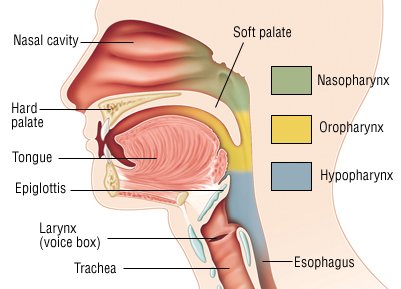
The second reason I never think this way or encourage singers I work with to think this way is because the vast majority of your resonance happens in a little place that I’d love to talk about.
That place is your pharynx.
If you snort, let your uvula flop back like your sawing logs at 3 AM (my wife reports I am expert at this these days, sorry sweetie) you’ll feel the spot.
? In the above pic, you’ll see the blue, yellow and green portions — those are where your prime resonant money’s at.
Makes sense, right? They’re directly north of your vocal folds.
Your folds vibrate, and then all that vibration gets bounced around and amplified right there in the recital hall of your vocal tract.
Feeling resonance in your mask is an EFFECT, and what you’re feeling is nanoseconds past tense. The vibrations you’re feeling there are the result of what just came through your folds and pharynx.
In my experience, when I’ve tried to aim for the front, sing into my mask, or hit any kind of back row through a lot of forward resonance, my body recruits all kinds of muscles to direct this feeling to this spot.
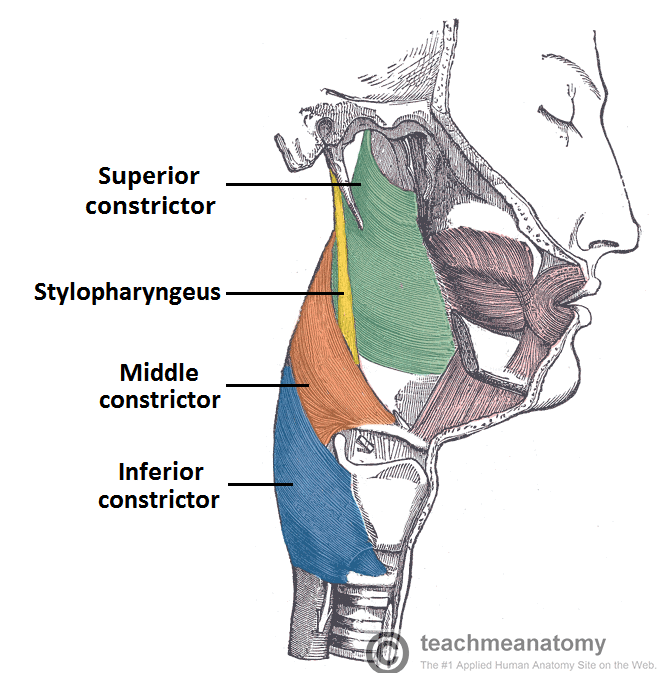
And this makes the pharynx muscles do the only things they can — constrict.
Lookit: (image courtesy of Teach Me Anatomy)
The green, orange, and blue muscle groups — they swallow for you hundreds of times a day. And the only thing they can do is get smaller.
To sing well, this mischief has to be managed. The softer and meltier these muscles are, the more room the recital hall (your pharynx) has to bounce sound waves around and amplify them.
If they’re squeezing just a little trying to laser beam your sound forward, well, you’re going to get a real samey, monochrome, bright metallic sound that honestly musical theatre gets made fun of for.
And for good reason — it’s dopey, and folks are missing out on all the individual color that the rest of their singular vocal tract can paint those sound waves with as they travel through.
So, what DO I do?
I encourage a dual perception — a centered awareness of the resonance vibrating through your vocal tract while your communication attention goes to your scene partner.
Musical theatre performers have to manage multiple awareness all the time.
I’m Christine Daae, I’m me, there’s the conductor, the audience is full tonight, that bobby pin is in too tight, maybe I’ll offer Raoul a breath mint later, I should have warmed up better before this show, I could use a nap, watch the conductor.
I’m astounded when folks believe we can’t think about vocal technique and storytelling at the same time. We have to. Humans have to think about more than one thing on the regular.
Yes, I know all the recent studies on how you can’t really multitask, and yes, hand raised.
But are you trying to tell me that when you’re scrubbing your tub you can’t sing “Alone” by Heart at the same time?
See?
I mean, anybody who’s sung and danced simultaneously can tell you that technique and singing can happen at the same time. Or else you fall over.
So here’s what I want you to understand:
Your primary resonance happens in your pharynx.
Folks can only hear what vibrates through your mouth and your nose.
Therefore, let’s do things that help these two factors happen as freely and efficiently as they can.
You might feel like your forehead’s gonna buzz right off your head, but someone could make a very similar sound and feel none of that.
Here are the questions you can ask yourself in order to find the sweet spot for efficient resonance and honest communication.
What are you singing?
What’s the world of the show or the song? Ado Annie’s gonna sing differently from A Little Night Music’s Ann, and she’s gonna sing differently from Ana in Frozen.
You’re a theatre singer. You make thousands of different sounds.
Once you know that,
What kind of breath support are you using?
“If I Loved You” support is gonna be very different from “Take Me or Leave Me.”
(”If I Loved You” is gonna have floatier ribs and be generated from the lower transverse abs and obliques [appoggio], and Rent is gonna have more rib closure and engagement which produces compressed phonation —
think toddler wailing over their banana being peeled the wrong way, broken, or slightly bruised. Those ribs know how to engage with the focal folds.
Then get a sense of the emotional impulse you’re working with.
Ado Annie: “It ain’t so much a question of not knowing what to do….”
Ann: “Soon, I promise. Soon I won’t shy away.”
Ana: “For the first time in FOREVER!….”
Three very different needs to communicate. These emotional images will light up in different parts of the body, and they’ll move the voice in a different way. Pay attention to your body on this.
Then, notice how that affects the phonatory pattern of the voice —
What happens when you notice the emotional energy of surmising, “It ain’t so much a question of not knowing what to do.”?
And how’s that different from Ann singing, “Soon, I promise….”?
And Ana’s got a completely different set of circumstances going on.
Your folds are going to sing these three different characters in different ways.
Now, it’s time to notice what the voice is doing just north of you larynx — in your pharynx.
Meditate your attention right back to that spot where your uvula vibrates against the back pharyngeal wall when you snort.
That’s the spot where I want you to notice your vibratory energy flowing past like a stream.
How does Ado Annie’s stream move?
How about Ann?
And Ana?
Notice the differences in air speed and how you feel the vibrations. Does that feel different from what you normally do?
Do you still feel sensations up in the front of your face? For me, I never think about them anymore. I may just be used to them, but I just don’t focus there.
Then after that, how can you shape your articulators and the rest of the tract to help you the most?
The one tip I have for you on this is to let your tongue float into your mouth. You want your tongue to float high and close to your hard palate.
This does at least 3 things:
1, it gets your tongue out of your most resonant place, your pharynx.
2, it floats the root of the tongue off of the larynx, so this whole mechanism has freedom to move.
and 3. When the tongue floats high toward the hard palate, it creates a very helpful acoustic bottleneck that causes sound waves to bounce back into the pharynx and amplify even more.
Then, the dialect of these characters, their self concept, and the world of the show are going to affect your articulation choices. Your entire body energy based on who you believe you are is going to shape how your tongue, teeth, and soft palate, and pharynx all interact.
And that’s the flow of energy that you have actual immediate control over. You can witness that as the actor/storyteller while looking to see if your communication is landing with your scene partner.
You can, in fact, do more than one thing at a time within a given task.
I hope this takes the pressure off of you to think you have to target and aim vibrations in a certain spot on your face. Sometimes you may feel sympathetic resonance galore in all kinds of places in your skull. Other times, you won’t.
That doesn’t matter. What does matter is that you are making free, efficient sounds that come from a deep belief and empathy for who you are being, and the story you are courageous enough to live.
Again, what I want you to walk away with from this is —
Your primary resonance happens in your pharynx. Nobody can hear your mask.
You can indeed think about vocal technique and storytelling at the same time. In fact, I believe they serve each other.
Trying to aim your voice in a forward direction can sometimes recruit muscles that decrease efficiency and cause unwanted constriction.
Then, when you’re working on any kind of material, ask yourself:
What world am I in? What am I singing?
What kind of breath support does this call for? What’s my body’s identity here?
How does this affect my phonatory pattern? What kinds of sounds am I making?
And then what do the resonances happening in my pharynx feel like as they flow through?
and then,
How do your articulators, affected by your body’s ego identity as this character or in this style, sculpt this vibration when it flows through your mouth?
And sub note on this, and this is a whole other topic — let your tongue float high and fill a lot of the mouth. It gets out of your pharynx, frees your larynx, and creates a terrific acoustic environment.
All of these things you have direct agency over. You can stand in your energy column, share generously, and observe how your scene partners respond with openness, curiosity, and play.
Practice these things, and reach out if you have questions at dan@dancallaway.com. Or click on “work with me” to find out how you can, well, work with me.
I’m all about getting you simple tools that make sense and work fast so that you can tell the stories you want to with joy, freedom and love, feel confident and excited at auditions, and contribute beautiful and satisfying work in whatever room you collaborate.
Because remember there is objectively, empirically, and scientifically only one you, and folks need to hear the story only you can sing. Now go sing. Bye. ?